Overview
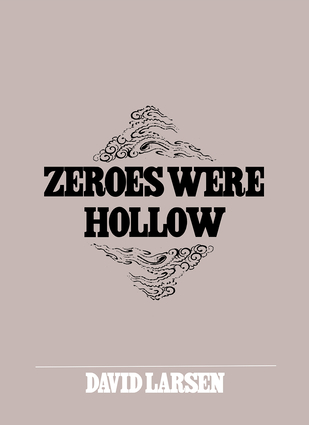
There is a tradition of dry, cerebral scholar-poets in which David Larsen is hard to place. As a translator, he performs sensitive work that preserves the alterity of medieval Arabic poetry without stooping to exoticism or hermetic dodges. His original poetry is an unconventional counterpart to this practice. It is profane, musical, and, as announced on the cover of Larsen's 2005 debut THE THORN, "easy to read." That book was archly described by Kevin Killian as "a book of anger, the fury that sweeps through the plain, the Abolitionist anger that made John Brown steal that ferry." Seventeen years later comes ZEROES WERE HOLLOW, a second book of poetry suffused with the wit of the gallows. "I was pleased as punch to let it lie," says the first poem, "but then the bug bit me," and indeed the book crawls with pests and vermin. By definition these are animals out of place, and ever-present familiars to the poet of ZEROES WERE HOLLOW. Amid the laughter, it is a solemn revolt against nihilism, and a monument to civic animus and loss of life whose marble is still warm to the touch.Reviews
"Larsen has a way of making everyday language absolutely wonderful, through off-kilter redefinitions of otherwise taken-for-granted concepts – e.g. dictionary entry: “The Day. Noun. That which has every hour in it” – and the employment of extraverbal language such as “and uh clouds everywhere.” We have the day as a vessel that holds hours and clouds, and then, forming a layer between the day and its contents, “some game inside to keep them warm.” The game could be an abstract form of play, or it could be a hunted animal, which supports “to keep them warm,” and then “time turned a pitcher” and so time becomes a vessel, too – we have a Matryoshka doll of concentric metaphors. The gaminess of this structure allows the reader to “misread” the line as “time turned a picture,” and sure enough, pages later, we find a black and white picture of an hourglass turned over, spilling out time like a pitcher."--Jared JosephAuthor Biography
David Larsen teaches at NYU in Liberal Studies. His translation of the Arabic NAMES OF THE LION (2017) by the grammarian Ibn Khalawayh received the Harold Morton Landon Translation Award from the Academy of American Poets.

 Distribution Programs
 Sales Channels
 Marketing Services
 Digital Services
 Specific Services for Publishers
 Operations