
Sign up today...
for featured titles, special offers, bestsellers, and more, in your inbox!
Close
Sign up today...
for featured titles, special offers, bestsellers, and more, in your inbox!

 Distribution Programs
 Sales Channels
 Marketing Services
 Digital Services
 Specific Services for Publishers
 Operations

FICTION
300 Pages, 5.5 x 8.5
Formats: Trade Paper, EPUB, Mobipocket
Trade Paper, $14.95 (US $14.95) (CA $17.99)
Publication Date: October 2014
ISBN 9781937584269
Rights: WOR
Trine Day (Oct 2014)
TrineDay Fiction
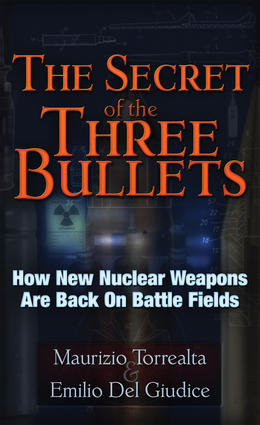
Four journalists found themselves traveling around the world with the aim of finding answers to some questions: Why was valid research into room-temperature fusion deliberately ignored? Why was enriched uranium found in a crater caused by a bomb in Khiam, Southern Lebanon? Why do depleted uranium bullets produce a temperature of 4000°C? Why are there traces of other radioactive elements in those bullets? How do the new bombs dropped on Gaza work, bombs that are able to amputate people’s legs while leaving no trace of metal fragments? The answers to these questions are linked to one another by a secret that has been kept hidden for more than 20 years: a discovery of a process in physics that has enabled the production of nuclear bombs the size of a bullet. Based on facts, The Secret of the Three Bullets is a scientific spy story that tells in fiction the reality behind cold fusion and its use on the battlefield today.
Maurizo Torrealta has worked as a journalist for 28 years. He is the director of the Italian weekly magazine Left Avvenimenti and the chief editor of investigative journalism for Rai News 24 in Italy. He has a PhD in political science from the University of Bologna. Emilio Del Giudice is a retired senior scientist at the Italian Institute for Nuclear Physics and formerly worked at the Theoretical Physics Center at MIT and the Niels Bohr Institute in Copenhagen. He was the recipient of the Prigogine Award in 2009.
